
Understanding Nano Technology Concepts
What is Nanotechnology?
Nanotechnology is comprised of science, engineering, and technology conducted at the nanoscale level (1–100 nanometers).
Fundamental Concepts in Nanotechnology
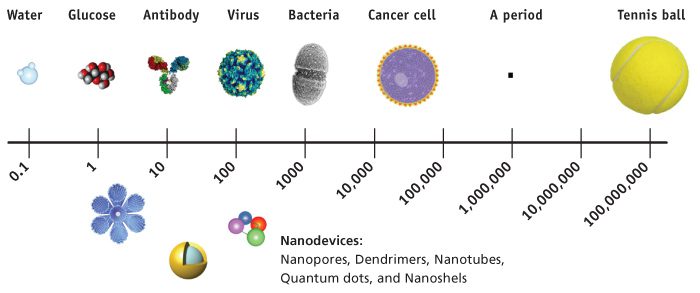
It’s no secret that nanotechnology is small! In fact, it’s difficult to envision exactly how small nanotechnology really is. One nanometer is a billionth of a meter, or 10⁻⁹ of a meter. Here are a few illustrative examples:
There are about 25,400,000 nanometers in an inch.
A sheet of newspaper is about 100,000 nanometers thick.
On a comparative scale, if a marble were a nanometer, then one meter would be the size of the Earth.
How Nanotechnology Started
Even before the term “nanotechnology” was coined by Professor Norio Taniguchi during his explorations of ultraprecision machining, physicist Richard Feynman referenced the ideas and concepts supported by nanoscience and nanotechnology in his talk entitled “There’s Plenty of Room at the Bottom” in 1959 at the American Physical Society meeting at the California Institute of Technology.
In his discourse, Feynman began early discussions around the process that enabled scientists to control the deployment of individual atoms and molecules. However, it wasn’t until the early 1980s that modern nanotechnology officially began, with the development of the scanning tunneling microscope that had the ability to actually see atoms.
Fundamental Concepts in Nanotechnology
Nanoscience and nanotechnology are associated with the ability to see and control individual atoms and molecules. Just about everything in this world contains atoms, including the food we consume, the garments we wear, the structures such as buildings and houses where we work and live, as well as our own bodies.
However, because atoms are so small, it is literally impossible to see them with the naked eye. In fact, the typical microscopes used in science classes to teach high school–aged students often don’t have the capacity to see them. Fortunately, specialized microscopes that can drill down and see things at the nanoscale were invented nearly 30 years ago to allow for this targeted viewing.
While modern nanoscience and nanotechnology are considered to be fairly new, the truth is that nanoscale materials have been in use for centuries. For example, different-sized gold and silver particles have been used by artists to create colors in stained glass windows of historic churches and cathedrals hundreds of years ago. They just didn’t realize it at the time. Scientists and engineers today, however, are discovering several different ways to intentionally make materials at the nanoscale in order to reap the benefits of their enriched properties. These include specific advantages such as increased strength, lighter weight, more control of the light spectrum, and greater chemical reactivity.
Precision at the Nano-Scale
From reduced bacterial adhesion to accelerated bone growth, our surface technology is the missing link in your device design. See the science behind our nanotube platform.